STATION
Station ownership
Bounded contributor authority
Own the work in your station. Never confuse local control with authority over the whole service.
KITCHEN OPERATIONS FOR HUMAN + AGENT WORK
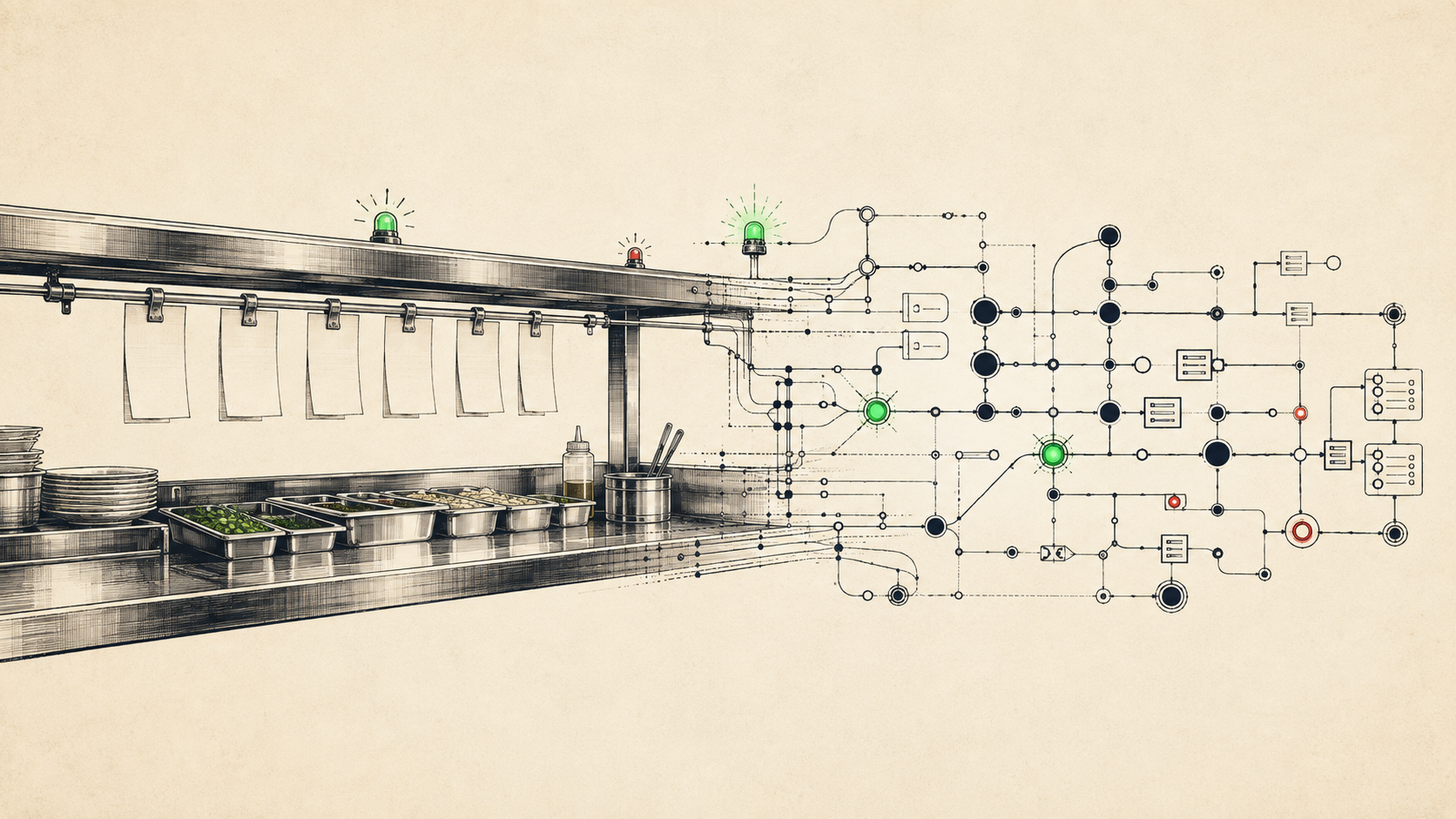
Professional kitchens already know how to coordinate parallel work, bounded authority, live dependencies, verification, exceptions, and whole-table completion. The Brigade Protocol makes that operating knowledge durable for humans and AI agents.
ORIGIN
It is an operating system translated from the line.
Kitchens teach maximum agency inside precisely understood boundaries. A cook must distinguish what is on their station, what they verified, what another station reported, what is firing, what is ready, what is low, and what only expo can authorize.
Axl Ibiza learned that discipline as a chef, pastry chef, and butcher—including taking whole pigs apart at their actual seams. The same method now governs evidence-led decomposition, agent coordination, and repository-scale transformation.
STATIONS
These are not colorful aliases. Each kitchen primitive defines an invariant the work system must preserve.
Bounded contributor authority
Own the work in your station. Never confuse local control with authority over the whole service.
Addressable work unit
If work cannot be named, linked, and inspected, it is not ready to enter the system.
Visible ordered work queue
The queue belongs in shared state, not in one person’s head or a disappearing conversation.
Live aggregate obligation
Compute the whole outstanding demand from every live ticket. Never optimize one ticket against a false total.
Authorized activation
Queued does not mean active. Work begins only when scope, prerequisites, and authority are clear.
Verified prerequisite state
Do not start execution until dependencies, tools, context, tests, and rollback paths are ready.
Explicit at-risk state
Signal declining capacity before it becomes failure. Early truth gives the system room to compensate.
Unavailable or blocked state
Remove impossible work from the promise surface immediately. Never let the system operate on phantom availability.
Pre-production conformance gate
Prove one complete representative result before asking the system to repeat it at scale.
Coordinated convergence
Local completion is not collective completion. Components arrive together or the table waits.
Maintainer integration authority
The station declares readiness. Expo sees the whole table, resolves conflicts, and authorizes release.
Campaign completeness
Success is the coordinated table—not a pile of locally correct, orphaned dishes.
THE RAIL
Software teams lose control when they collapse seven distinct states into “in progress” and “done.” A kitchen never could.
Named and visible
Ordered in live work
Prerequisites proven
Authorized to begin
Locally verified
Converging at the pass
Integrated and released
Receipt and understanding only. Not agreement or approval.
Capacity or confidence is declining. Signal before failure.
Unavailable, blocked, withdrawn, or no longer safe to promise.
Exact request for review, direction, capacity, or integration help.
Shared-surface and collision warning before either actor collides.
Return failed work to execution with the defect made explicit.
HEARD ≠ AGREED.
REVIEWED ≠ APPROVED.
READY FOR PICKUP ≠ MERGED.
TABLE READY ≠ SOLD.
SERVICE
A compact operating doctrine for humans, agents, reviewers, and maintainers working one service from many stations.
Take full responsibility inside its boundary. Do not impersonate authority outside it.
Make work addressable, inspectable, and bindable before acting on it.
Derive total demand from live relationships—not memory or the loudest ticket.
Verify prerequisites, manifests, evidence surfaces, and rollback paths.
Sequence execution around the real integration surface.
Never silently upgrade acknowledgment into agreement or approval.
Announce shared-surface movement before it becomes collision.
Exceptions are operating signals. Make them precise while options remain.
Bind work, actors, evidence, state, provenance, and authority in durable form.
Name the failed assumption and the new acceptance condition.
Present a complete local contract with checks, limits, and provenance.
Optimize for campaign convergence without erasing who made it possible.
COORDINATION
THE CORE PRIMITIVE
A durable, authority-aware coordination record that binds work, actors, dependencies, collisions, evidence, receipts, provenance, and required state transitions at every shared surface.
INTERLOCK is not project-management metadata. It is a repository-native coordination protocol: the context layer that makes multi-actor work composable without requiring everybody to occupy the same room—or the same moment.
A new category: coordination engineering as code.AN INTERLOCK EXPOSES
COMPLETION INVARIANT
LOCAL GATES+REQUIRED EDGES+PROVENANCE+AUTHORIZED TRANSITION
If any term is missing, the work may be locally correct—but the campaign is not complete.
THE ASYNCHRONOUS SERVICE RULE
“This meeting could have been a Git INTERLOCK.”
Meetings create shared moments. INTERLOCKS create shared state.
A person or agent surfaces a fact
The fact enters the canonical object
Affected work and actors receive edges
The next state and authority are explicit
The next actor continues without a meeting
THE CUT
A trained butcher does not impose imaginary boundaries on a whole animal. They read structure, tension, joints, connective tissue, and the intended cuts. Evidence-led decomposition does the same to a codebase.
WHOLE-PIG ENGINEERING
Prove the structural and historical seam before splitting the system.
READ THE TISSUE
Run the representative path through the real contract. Only then repeat it across the campaign.
Rebuild valuable prior contributions against current main, preserve authorship, run the current gate, and bind old and new paths with explicit lineage.
UPTAKE
The proof is not that people repeated a memorable word. The proof is that other contributors used the objects, vocabulary, state, and ordering rules to situate their own work almost immediately.
39m 42s
A peer contributor turned the new campaign object into a living parity matrix, an Interlock column, GAP identifiers, phases, and bound follow-on work.
Inspect PR #80010 ↗2h 17m
After a formal interlock notice set the overlap and land order, the other PR author accepted the option and their future rebase obligation.
Read the receipt ↗33m 48s
The original contributor adopted both the word and the process: current-main salvage, gate enforcement, authorship preservation, and no duplicate work.
Read the adoption ↗Conversation supplied observations. Repository artifacts retained the repaired coordination state, made the next action obvious, and let independent actors continue the service.
MACHINE-INGESTIBLE HANDOFF
Copy the complete doctrine into Hermes, a GPT, an agent system prompt, or a repository instruction file. The Markdown includes vocabulary, authority, state semantics, INTERLOCK fields, the execution loop, required behaviors, and a standard status report.
---
protocol: brigade-v1
core_primitive: INTERLOCK
canonical_coordination_surface: repository
synchronous_coordination_policy: exception-path
---

PRIME DIRECTIVE
Exercise maximum agency inside precisely
understood boundaries.

STATION: <bounded area owned>
STATE: <exact service state>
INTERLOCKS: <edges + land order>
AUTHORITY BOUNDARY: <cannot decide>
NEXT TRANSITION: <actor + evidence>